
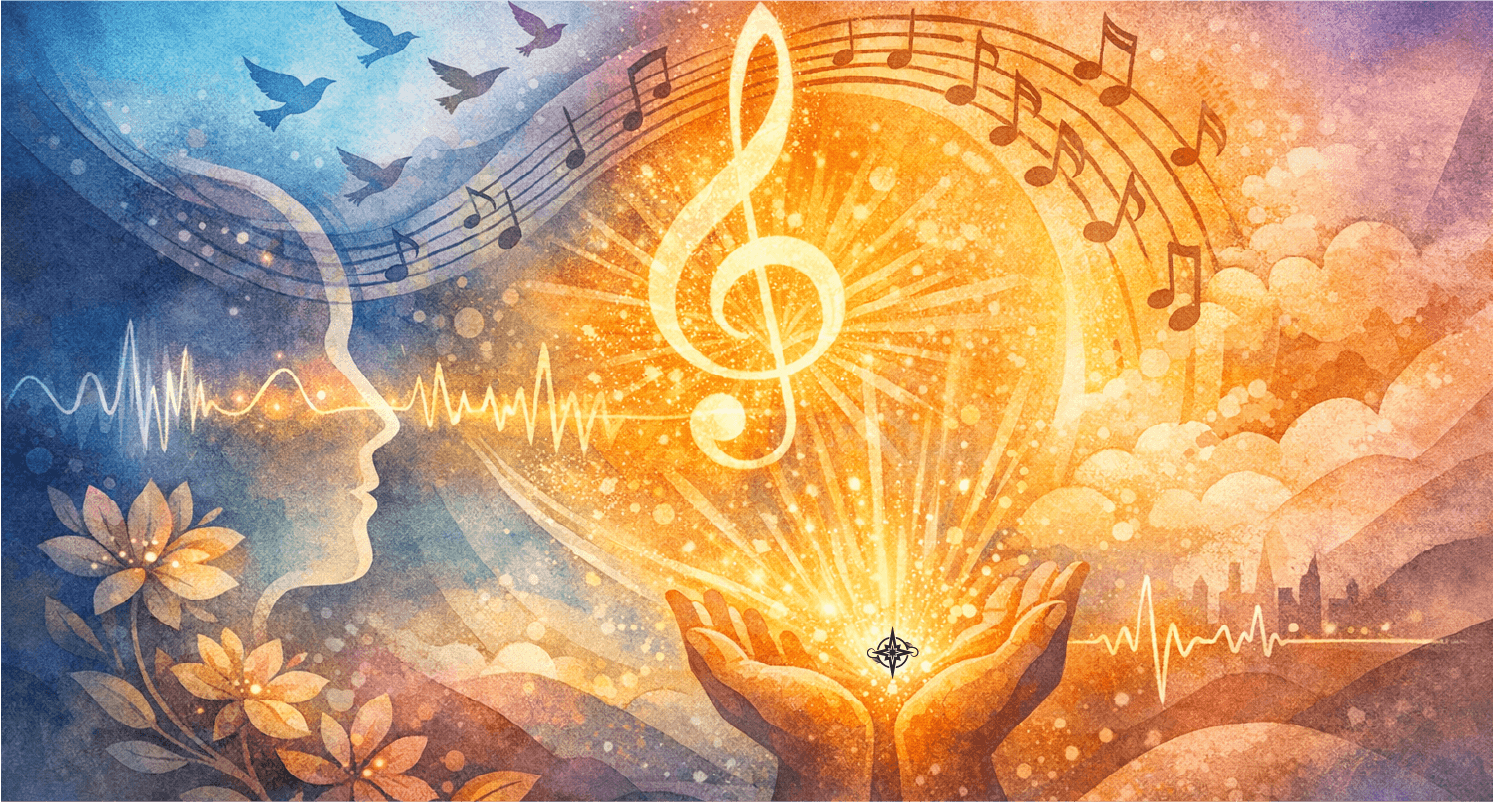
Imagine: You’re in a room where fifty people gradually begin to breathe in closer alignment. Heart rates begin to sync.
This isn't a metaphor. You’re not in a meditation center or a medical research lab.
You are in a choral rehearsal.
Music doesn’t merely accompany our lives; it organizes, reflects, and at times, repairs them.
This year marks twenty years of Chorus Polaris and two hundred fifty years of American musical tradition. The anniversary year invites us to look not only backward at what has been built, but forward at what we are still becoming. April — dense with observances celebrating art, healing, diversity, structure, language, and hope — offers the perfect lens. It reminds us that choral music is not just something we perform. It’s something we practice together: a way of being human.
The Communal Instrument
Choral music offers a uniquely powerful model of collective expression. A choir is not a cluster of soloists – it’s a living, breathing organism. Each voice is distinct, yet inseparable from the whole.
In a month that celebrates National Poetry Month and Jazz Appreciation Month, this truth becomes especially vivid. Jazz thrives on individuality within structure; choral singing demands both individuality and surrender. Diversity here isn’t decorative. It’s the architecture itself, built from different timbres, backgrounds, and life stories woven into something greater.
This dynamic reaches far beyond the music stand and practice room. In a fractured world, a choir becomes a rehearsal for civic life: learning to listen deeply, adjust in real time, and co-create what no one could achieve alone. You feel it in the way a single missed entrance ripples through the ensemble — or when perfect alignment lifts everyone higher.
Music as Therapy – Literally
World Music Therapy Week (April 10–15) reminds us that music’s healing properties are not metaphorical. Neurologically, it lights up multiple regions of the brain at once — memory, emotion, movement — all firing in concert. For individuals navigating stress, trauma, or neurological conditions, structured musical engagement can lower cortisol, stabilize mood, and even aid language recovery.
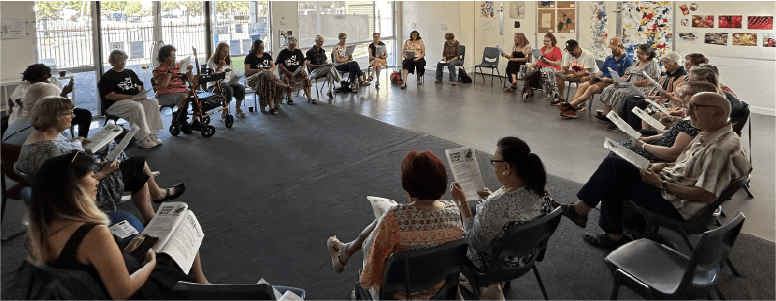
Choral singing amplifies these effects. When voices align in synchronized breathing and phrasing, heart rates begin to sync too. Studies show this co-regulation creates a physiological cascade of calm and resilience. In the circle of a choir, this healing becomes shared care.
It’s a full-body experience: the vibration of the sternum, the expansion of the ribs, the cool rush of air. This physical grounding gently forces the 'fight or flight' response to take a back seat.
The Hidden Mathematics of Sound
At first glance, Mathematics and Statistics Awareness Month may seem an odd companion to poetry and jazz. Yet music gives audible form to mathematical relationships. Rhythm is structured time. Harmony is the ratio of frequencies. Form is pattern recognition stretched across duration. In a world of erratic pings and notifications, the steady pulse of a 4/4 time signature can act as a metronome for a racing heart.
For choral musicians, this isn’t theoretical. It’s embodied knowledge. Tuning a chord requires an intuitive grasp of frequency relationships. Maintaining tempo demands internalized proportion. Even the architecture of a well-crafted choral work reflects mathematical clarity: symmetry, variation, development.
This structural integrity contributes to music’s therapeutic power. In chaos, it offers a reliable experience of order: predictable yet dynamic, constrained yet expressive. Music liberates rather than confines.
Poetry Alive in Sound
Just as a handwritten letter carries the unique grain of a person’s handwriting, a choral work carries the unique grain of the human voice. National Poetry Month and National Card and Letter Writing Month bring the written word forward. We remember that some things are too important for a text message. They require the slow, intentional delivery of a person’s breath or pen.

Choral music animates language through vibration. A poem set to music gains rhythm you can feel in your chest, imagery that unfolds in time, and emotional layers deepened by harmony and vocal color.
Singers engage both intellect and heart. Listeners receive meaning that lands immediately yet lingers in complexity. When emotions feel too big, too vague, or too heavy to name, choral music gives them shape and voice – an essential articulation in uncertain times.
Hope as Active Practice
Easter (April 5) and the National Month of Hope turn our attention to renewal and resilience. Choral repertoire often grapples directly with these themes: sacred works tracing suffering to redemption; secular pieces celebrating human endurance.
Crucially, hope in music isn’t passive wishing. It’s enacted. Each rehearsal is an act of faith: that scattered voices can converge, that disciplined effort yields coherence, that beauty will emerge from collaboration. Each performance offers that belief to the world.
Art as Daily Practice
World Art Day (April 15) reminds us that artistic expression is not reserved for special occasions. For choirs, rehearsal turns art into rhythm — the weekly return to the risers, the tuning pitch, the first downbeat – a discipline that integrates body, mind, and community.

This consistency matters. In the context of National Stress Awareness Month, the predictable schedule, the physical release of singing, and the social bonds formed in shared vulnerability all build stability amid life’s turbulence. Art, then, is neither luxury nor an escape. It becomes a framework for engaging with life more fully.
Conclusion: A Month, A Model
It begins with breath: shared, measured, attentive.
It ends the same way.
In between, something shifts. Individual voices align into an ensemble.
A choir models a healthy society: attentive, responsive, and oriented toward shared creation.
In the act of singing together, we do more than make sound.
We practice being human.
Together.
And in that practice, there is healing.